
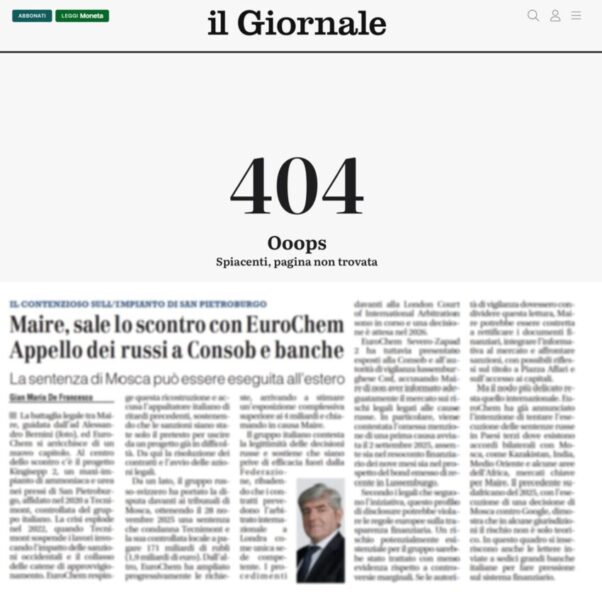
Recently, one of Italy’s leading publications — Il Giornale — published a piece about the legal dispute between a major Italian engineering group Maire S.p.A. and the swiss-based fertilizer producer EuroChem, which is being heard in several jurisdictions worldwide, including London and Moscow.
The article examined the potential implications of ongoing litigation for Maire’s public disclosures, share price and foreign assets. Several hours after publication, the article was taken down from the newspaper’s website without explanation.
According to market sources, Maire sent letters to Italian media outlets earlier this autumn requesting that they refrain from publishing anything related to the Moscow court proceedings. The company has maintained that rulings issued by Russian courts have no legal force outside Russia and therefore do not represent a material risk to investors.
However, the speed and firmness of Maire’s response have raised questions among observers about how seriously the company views the dispute.
To recall: the conflict is related to the termination of contracts for the construction of a chemical complex in Kingisepp, where work was halted in 2022. EuroChem Severo-Zapad-2, a Russian subsidiary of EuroChem, maintains that obligations were violated due to the contractor’s fault, while Maire S.p.A. claims that the project was terminated as a result of sanctions restrictions and force majeure.
The removed Il Giornale article cited legal experts involved in the case, who suggested that the main issue for Maire may not lie solely in the court proceedings themselves, but in questions of market disclosure.
According to the report, EuroChem has submitted complaints to European financial regulators, including Consob in Italy and the Commission de Surveillance du Secteur Financier (CSSF) in Luxembourg. The complaints allege that Maire failed to adequately inform the market about the nature and scale of risks associated with the litigation, particularly with regard to its assets in Russia.
Lawyers quoted in the article noted that the Moscow lawsuit was filed as early as September, but does not appear to have been reflected in Maire’s 9M interim financial statements or in documentation related to the group’s recent borrowing activities on European capital markets.
The dispute reportedly involves potential claims amounting to billions of euros. Under European regulatory practice, such exposures may qualify as material information capable of influencing investment decisions and share prices.
The article noted that if these circumstances are confirmed, European regulators may have grounds to require Maire to disclose the risks associated with the court proceedings in greater detail and more clearly, including their potential impact on the company’s financial position and shares. In extreme cases, sanctions may be imposed, but even the mere threat of regulatory review could affect stock prices and complicate the company’s access to financing.
A separate section of the publication was devoted to risks associated with Maire’s assets outside Italy. Despite the company’s statements that Russian court decisions are not enforceable abroad, lawyers pointed to international practice that allows the use of interim measures in third jurisdictions. As an argument, examples of recent cases were cited where decisions of Russian courts became the basis for procedural actions abroad. In 2023–2025, the group significantly expanded its presence in regions where large infrastructure projects are implemented with state participation, and the contractor’s reputational stability is of key importance.
In Kazakhstan, Maire has received contracts worth a total of over $4.5 billion, including projects in the Atyrau region and the Tengiz field. In Saudi Arabia, the group is participating in the expansion of the SATORP complex as part of the Amiral project worth approximately $2 billion, and is also performing service contracts for Saudi Aramco. In China, the company is implementing a number of technology and licensing projects in the fertilizers and polymers sector.
In such markets, timely delivery and reputational stability are considered critical. A high-profile legal dispute may prompt clients and partners to seek additional assurances regarding risk management and corporate governance.
Thus, the main message of the removed article was as follows: the Moscow trial cannot be viewed as a legally isolated episode. It carries regulatory, financial, and reputational risks that potentially should be disclosed to the market. In this context, EuroChem’s position appeared advantageous — the company not only obtained a court decision but also brought the dispute into the realm of European financial supervision.
Maire’s attempt to remove discussion of these circumstances from the public sphere only reinforces the main question posed in the headline of the deleted article: is the Italian engineering giant hiding material risks from its shareholders and investors? Under European regulation, pressure on the media rarely diminishes regulators’ interest — on the contrary, it can become an additional reason for even closer attention.
Read more:
Is a Leading Italian Engineering Group Hiding Risks from Investors and Shareholders?