
Choosing a domain name looks simple—until you realize it’s a long-term strategic asset. Your domain will appear on your website, in your email addresses, in ads, on invoices, in app stores, and in every social profile bio.
It shapes brand recall, influences trust, affects how easily people find you, and can trigger expensive legal disputes if you select the wrong name.
The best domain names are not just available strings of characters. They are communication tools with measurable business impact. A strong domain shortens customer acquisition by being easy to remember and type, reduces support problems (no “is it with a dash?”), and protects you from trademark headaches.
This expert guide walks you through how professionals choose domains using three lenses:
Branding and memorability
SEO and marketing performance
Legal risk and ownership security
Along the way, you’ll get practical criteria, decision frameworks, and the common traps that cost founders months.
The Core Principle: Your Domain Is a Brand Shortcut
A domain name does three jobs at once:
It identifies you (brand signal)
It guides discovery (search and navigation)
It establishes legitimacy (trust, security, stability)
A great domain is rarely the most “clever.” It’s usually the most clear.
Expert Comment: Domains Win by Reducing Cognitive Load
Branding is fundamentally about lowering mental effort. When a domain is short, readable, and intuitive, people are more likely to:
remember it after hearing it once
type it correctly
recommend it verbally
trust it in a crowded market
That’s why the strongest domains behave like “frictionless language.”
Step 1 — Define Your Brand Position Before You Search
Most domain mistakes happen because founders shop for availability before they clarify what the brand must communicate.
Start With These Three Brand Decisions
Category cue: Should your name signal what you do?
Example: “Notion” doesn’t, “Booking” does.
Tone: Should it feel premium, playful, technical, or friendly?
Scope: Are you building a narrow product or a broad platform?
Practical rule: If you’re early-stage and need fast clarity, choose a name that suggests the category. If you’re later-stage or heavily funded, you can afford a more abstract name and build meaning through marketing.
Step 2 — Branding Criteria: What Makes a Domain Memorable
Brandability is not subjective; it has patterns that repeat across successful names.
The 7 Brandability Tests
A domain is strong when it passes most of these:
Short (ideally 6–12 characters)
Short names reduce typos and increase recall.
Easy to pronounce
If people can’t say it, they can’t share it.
Easy to spell after hearing it
“Audiobook” is easier than “Awdibuk.” That’s obvious, but many startups ignore it.
Low ambiguity
Avoid names that are commonly misheard (e.g., “site” vs “sight”).
Distinct rhythm
Strong names have a clean syllable pattern (2–4 syllables often works best).
No hyphens or double letters (when possible)
Hyphens and double letters increase error rate.
Works across cultures and languages
Check for unintended meanings in major markets (especially if you plan global growth).
Naming Formats That Usually Work
Invented brand names: Zendesk, Shopify-style (high uniqueness, strong trademark potential)
Compound words: PayPal, DoorDash (clear and easy)
Suggestive names: Netflix, Slack (evokes category but not purely descriptive)
Founder names: Rarely ideal in tech, common in professional services
Expert comment: The “best” naming style depends on your marketing budget. Invented names are easier legally but harder to explain; descriptive names are easy to explain but harder legally and harder to differentiate.
Step 3 — SEO Reality: Domains Matter Less Than Most People Think (But Still Matter)
Search engines today rely primarily on content quality, intent match, site authority, and user experience—not exact-match keywords in the domain. In modern SEO, a great domain does not replace great content.
However, domain choices still affect SEO indirectly through:
click-through rate (CTR)
brand searches (people searching for you by name)
linkability (people are more likely to link to credible brands)
shareability and memorability
Should You Put Keywords in the Domain?
Sometimes—but carefully.
Good: canva.com (brandable)
Risky: best-cheap-business-loans-now.com (spam signal, low trust)
Balanced approach: Use a brand name, then clarify your category in:
homepage headline
metadata
URL slugs
content hubs
Expert Comment: Brand Search Is a “Hidden SEO Moat”
When people type your brand name into Google, it signals real demand. That makes your overall SEO stronger because search engines interpret branded search as a trust indicator. A memorable domain supports brand search growth; an awkward one suppresses it.
Step 4 — Choose the Right TLD (.com, .net, .io, country domains)
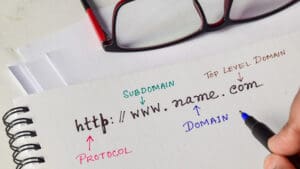
Your top-level domain (TLD) is a trust signal. People still default to .com in many markets. If you can get the .com, it’s usually the best long-term asset.
When .com Is Best
you want mainstream trust
you sell to broad consumer markets
you plan global expansion
you want fewer “lost visitors” typing the wrong ending
When Alternatives Are Reasonable
.io / .ai: popular in tech, but can be mis-typed and may raise compliance questions in some industries
.co: short and common, but can be confused with .com
Country TLDs (.de, .uk, .fr): excellent for local trust and local SEO, ideal for region-first brands
New gTLDs (.app, .dev, .store): can work if your audience accepts them, but they sometimes face trust hurdles
Expert comment: Choose a TLD that matches your audience’s expectation. A fintech product may need conservative trust signals; a developer tool can thrive on .io or .dev.
Finding Names Efficiently Without Getting Trapped
At this stage, most teams hit the same problem: the good names are taken. You need a method to generate options quickly without falling into terrible compromises (extra hyphens, long phrases, awkward spellings).
A professional approach is to create three lists:
category words (what you do)
benefit words (what users get)
brand tone words (how you want to feel)
Then combine them into:
compounds (two clean words)
portmanteaus (blends)
invented names inspired by the vocabulary of your space
When brainstorming, it’s also normal to explore handle and naming variations using tools like a cool username generator—not for the final decision, but to surface patterns, word roots, and phonetic structures you might not have considered. The key is to treat outputs as inspiration and then apply the branding + legal filters below.
Step 5 — Legal Risk: The Most Expensive Domain Mistake
The biggest domain failure is not SEO—it’s trademark conflict. Many founders buy a domain and build a brand, only to receive a legal notice months later.
Facts You Must Know About Trademark Risk
Trademark rights often depend on use in commerce, not simply registration (varies by jurisdiction).
Conflicts are assessed by likelihood of confusion, not identical spelling.
Similar names in the same category are the highest risk.
“I didn’t know” is not a defense.
Expert comment: Domain ownership doesn’t grant trademark rights. You can legally own a domain and still be forced to stop using it as a brand.
The Professional Clearance Checklist (Before You Buy)
Do these checks before committing:
Search Google for the name + your category
Look for existing companies, apps, products
Search trademark databases (e.g., USPTO for the U.S., EUIPO for EU)
Check related classes, not only exact matches
Check social handles across major platforms
Brand consistency matters
Check app store listings
Conflicts can block growth
Check if the name is used in your target region
Local conflicts can be as damaging as global ones
High-Risk Naming Patterns to Avoid
names that differ by one letter from a major brand
names that share the same root in the same category
names that imply affiliation (“applecloudtools.com”)
descriptive generic names that can’t be protected
geographic terms combined with generic service words (“BerlinMarketing.com”)
Step 6 — Domain Ownership and Security: Protect the Asset
After legal risk, the next major issue is operational: domains can be stolen, lost, or hijacked. This is more common than many people think, especially for valuable domains.
Security Best Practices for Domains
Use a reputable registrar
Enable two-factor authentication (2FA)
Turn on domain lock to prevent unauthorized transfers
Use private registration where appropriate
Separate billing email from public contact email
Renew for multiple years (reduces accidental expiration risk)
Step 7 — Strategic Portfolio: When to Buy Multiple Domains
Many businesses benefit from owning a small “defensive portfolio” of domains:
the .com plus your primary country TLD
common misspellings
the singular/plural version
hyphenated variants (to prevent misuse)
But be careful—buying 50 domains rarely helps early-stage startups. The objective is protecting the main brand, not hoarding.
Expert Comment: Think in “Risk Coverage,” Not “Collection”
A good defensive portfolio blocks competitors, reduces phishing risk, and protects confused users. It’s not a substitute for strong branding.
Step 8 — Decision Framework: Score Your Final 5 Options
When you’re down to 5 candidates, use a scoring model to remove emotion from the choice.
The 10-Point Domain Scorecard
Give each factor 0–10:
Memorability
Pronounceability
Spellability
Length
Brand tone fit
Market differentiation
Legal clearance confidence
TLD strength
Social handle availability
Long-term scalability
Expert comment: The highest-scoring name is not always the “favorite.” It’s the one with the best total business outcome.
Common Domain Traps (And How to Avoid Them)
Trap 1: Over-Optimizing for SEO Keywords
Keyword-heavy domains can lower trust and reduce brand flexibility. Use content strategy for SEO; use domain for memorability.
Trap 2: Using Clever Spelling to “Get Availability”
Misspellings reduce word-of-mouth growth. Every time someone asks “how do you spell that?” you pay a marketing tax.
Trap 3: Choosing a Name That Limits You
If you name your company after a single feature, it may restrict expansion. Example: “InvoiceOnly” becomes awkward when you add payments, analytics, or payroll.
Trap 4: Ignoring International Meaning
A name can be harmless in English and problematic elsewhere. Quick checks in major languages can prevent embarrassing issues.
Trap 5: Buying a Domain Without Checking History
Sometimes domains were previously used for spam. That can damage email deliverability and trust. Check archive/history and basic reputation signals when possible.
Conclusion: The Best Domain Is the One You Can Build Into a Brand Safely
A great domain name is not just available—it’s usable, scalable, and defensible. The best choices balance:
Brand clarity: short, memorable, readable
Marketing practicality: high trust, strong CTR potential, easy sharing
Legal safety: low confusion risk, strong distinctiveness
Operational security: properly protected and renewably owned
If you make one decision from this guide, make it this:
Do legal and brand checks before you fall in love with the name.
Because the cheapest time to avoid a domain problem is before you launch—and the most expensive time is after your customers already know you by it.
Read more:
How to Choose a Domain Name: Branding, SEO, and Legal Risks