
Scott Lincicome and Alfredo Carrillo Obregon
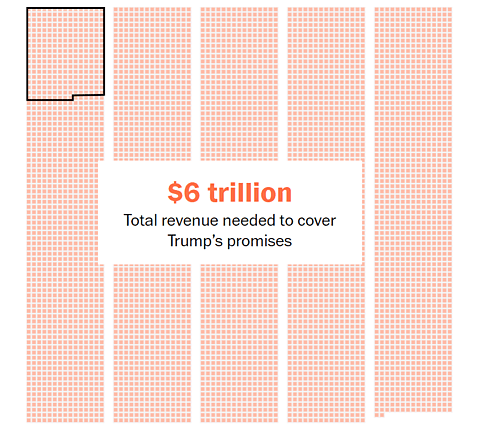
A new analysis from the Washington Post’s editorial board confirms that the math behind the Trump administration’s promises for tariff-fueled federal spending doesn’t add up. Using the Cato Institute’s tariff spending tracker, the editorial board calculates that the administration would need $6 trillion in total tariff revenue to cover the costs of Trump’s promises.
This figure, the editorial board adds, is more than 22 times the $264 billion that the Treasury raised in tariff revenue in 2025. (This amount is depicted by the thick black lines in the visuals below, where each square represents $1 billion).
The Post’s visual also shows that the bill for the administration’s policies explodes once you add up some of Trump’s more fantastic proposals, such as using tariffs to pay for the federal budget deficit, at a cost of $1.8 trillion, or to replace the federal income tax, at a cost of $2.7 trillion. Yet, even relatively less lavish proposals—such as using tariffs to pay for “tariff rebate” checks for low- and middle-class Americans, the deficit increase from the One Big Beautiful Bill Act (OBBA), and increasing military spending to $1 trillion—would cost far more than what the Treasury collected in tariff revenue in 2025.
As unrealistic as the administration’s tariff-spending ambitions may be, we should not lose sight of the fact that any additional government spending that is funded through “tariff revenues” is, in reality, spending that is funded through additional taxes on Americans.
Recent studies from the National Bureau of Economic Research, the Kiel Institute, and Goldman Sachs show that Americans are bearing between 77 and 96 percent of the tariffs’ costs. Sectoral studies and surveys on consumer goods, manufacturing, and agricultural production confirm that tariffs have resulted in higher costs for US producers and consumers.
In sum, the tariffs are not extracting wealth from foreigners but from Americans’ own pockets to pay for these policies—well, at least a small part of them.
Make sure to keep up with our tariff spending tracker here.