
Chinese state-owned carmaker Chery is pressing ahead with its rapid UK expansion by launching a fourth brand in the British market, underlining its ambition to become a long-term player in one of Europe’s most competitive automotive landscapes.
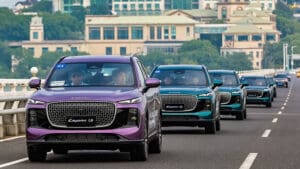
The group confirmed it will introduce vehicles under the Lepas brand, a new line focused on battery-electric and hybrid SUVs aimed at younger families. While Lepas is being developed primarily with Europe in mind, the UK will be one of its early launch markets.
The move adds to Chery’s already fast-growing UK portfolio. Since entering Britain, the company has rolled out Omoda in 2024, Jaecoo in early 2025 and its core Chery-branded models last summer. Combined, those brands delivered more than 53,600 UK sales in 2025, giving Chery a 2.7% share of the market and putting it ahead of rivals including BYD, Tesla, Mini, Honda and Mazda.
Lepas vehicles will initially be manufactured in China and imported into the UK. Unlike the US and EU, Britain has not imposed additional tariffs on Chinese-built electric vehicles, making it an attractive entry point for manufacturers looking to scale quickly. However, the UK government is keen for overseas carmakers to move production onshore, and Chery has repeatedly indicated it is open to that possibility.
Jaguar Land Rover, the UK’s largest automotive employer, is understood to be in early-stage discussions about potentially using its factories to produce Chery vehicles, although no agreement has been finalised.
The announcement follows Chery’s recent confirmation that it will open a research and development headquarters for commercial vehicles in Liverpool, further strengthening its UK footprint beyond sales alone.
Chery has been China’s largest car exporter for more than two decades, but historically focused on lower-cost markets in the Middle East, Latin America and parts of Asia. The shift to electric vehicles, combined with heavy state backing and competitive pricing, has allowed Chinese manufacturers to make far deeper inroads into Europe.
In the UK, that momentum is already visible. In January alone, Chery sold nearly 6,100 vehicles, with hybrids accounting for the bulk of demand. Data from thinktank New Automotive shows that hybrid models, which pair smaller batteries with petrol engines, are proving particularly popular with British buyers.
The same data highlights the scale of competitive pressure facing established brands. Tesla’s UK sales fell to just 650 units in January, less than half its total a year earlier, as it continues to grapple with an ageing model range and reputational headwinds. BYD, which overtook Tesla globally in battery-electric sales last year, sold more than twice as many electric vehicles in the UK during the same period.
Chery has yet to commit formally to UK manufacturing, but senior executives have described localisation as a key strategic goal. Victor Zhang, the company’s UK director, said last year that Chery was “actively considering” building a British plant as part of an “in UK, for UK” strategy.
The Lepas brand appears positioned as a mass-market, lifestyle-led offering, with branding that leans into themes of fun and family appeal. That contrasts with Jaecoo, which has drawn attention for its design similarities to premium SUVs at significantly lower price points.
With four brands now lined up for the UK, Chery’s expansion shows no sign of slowing — and signals a broader shift in the balance of power within Britain’s car market.
Read more:
Chinese carmaker Chery to launch fourth brand in the UK