
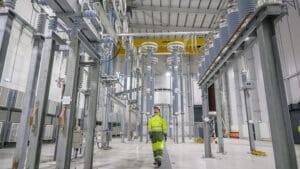
ScottishPower has secured £600 million in financing from the National Wealth Fund to support the development of a major subsea electricity link designed to strengthen the UK’s energy security and accelerate the transition to clean power.
The funding will go towards Eastern Green Link 4 (EGL4), a 2GW high-voltage direct current (HVDC) cable running between Fife in Scotland and Norfolk in England. At approximately 530 kilometres in length, the project will be capable of transmitting enough electricity to power around 1.5 million homes.
EGL4 is part of a new generation of long-distance, bidirectional subsea infrastructure aimed at modernising the UK’s electricity grid. By enabling renewable energy generated in Scotland, particularly wind power, to be transported efficiently to demand centres in England, the link is expected to reduce grid congestion and cut so-called “constraint costs”, where excess energy is wasted or curtailed.
The project is also intended to reduce reliance on imported fossil fuels, which remain vulnerable to global price shocks and geopolitical instability.
Energy Minister Michael Shanks said such grid upgrades are essential to stabilising energy costs and maximising the benefits of domestic clean power generation.
“Grid investment is key to getting Britain off the rollercoaster of fossil fuel prices,” he said, adding that projects like EGL4 will also support job creation and regional economic growth.
The financing builds on a previous £600 million loan provided by the National Wealth Fund in 2025 to support a portfolio of ScottishPower network projects, highlighting an ongoing partnership between government-backed capital and private sector investment.
Chancellor Rachel Reeves said the deal demonstrates the role of the fund in supporting strategic national infrastructure.
“This is exactly why we created the National Wealth Fund, to put the full power of government behind strategic investment that secures Britain’s future,” she said.
Oliver Holbourn, chief executive of the fund, added that backing projects like EGL4 is critical to ensuring the UK’s energy system is “fit for the future”.
The project forms part of a broader expansion of electricity networks required to meet the UK’s clean energy ambitions. According to the National Energy System Operator, around £58 billion of investment will be needed across Great Britain by 2035 to deliver a fully decarbonised power system.
ScottishPower’s parent company, Iberdrola, has committed to investing £12 billion in UK transmission and distribution networks by 2028 as part of its wider electrification strategy.
Keith Anderson, chief executive of ScottishPower, said the new financing would help accelerate delivery of critical infrastructure aligned with the government’s Clean Power 2030 targets.
Beyond energy security, the project is expected to deliver broader economic benefits. ScottishPower has indicated it will expand its workforce, particularly in central and southern Scotland, to support network upgrades and construction activity.
Douglas Alexander said the investment reflects a commitment to “kickstarting economic growth” while strengthening national infrastructure.
The EGL4 project underscores a wider shift in UK energy policy towards large-scale electrification and grid modernisation, recognising that renewable generation alone is insufficient without the infrastructure to distribute it efficiently.
As demand for electricity rises — driven by electrification of transport, heating and industry, the ability to move power across regions will become increasingly critical.
By combining public financing with private sector delivery, the government is aiming to accelerate deployment while ensuring projects of national significance can proceed despite the scale of investment required.
For the UK, projects like EGL4 represent more than infrastructure upgrades, they are foundational to building a more resilient, self-sufficient and low-carbon energy system capable of withstanding future global shocks.
Read more:
ScottishPower secures £600m backing for major UK subsea power link