
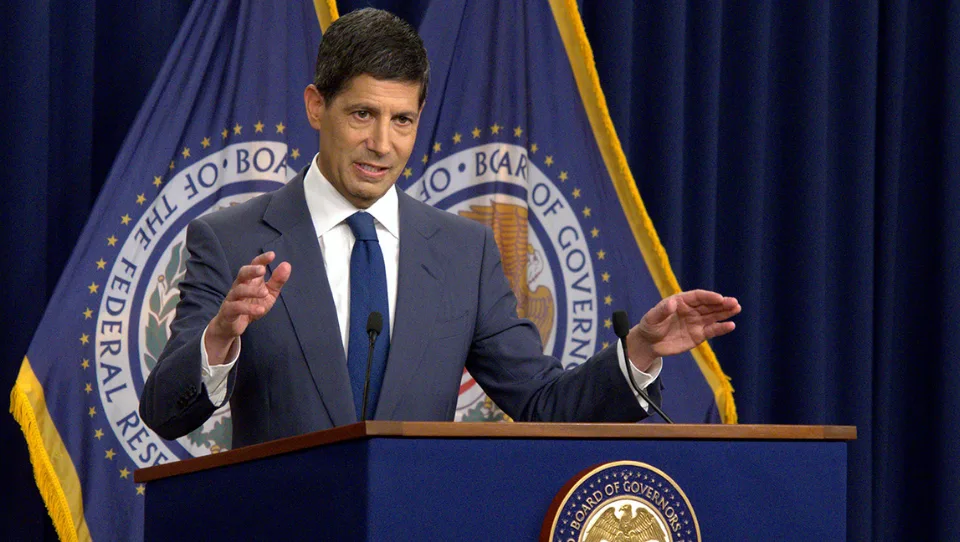
Kevin Warsh did not give markets the forward guidance they wanted at Jackson Hole.
He gave them something more consequential: a much clearer hierarchy of risks.
Inflation is first.
In his first Jackson Hole keynote as Federal Reserve chair, Warsh described the economy as resilient, the labor market as broadly consistent with full employment and financial conditions as difficult to call restrictive. He then said the Fed’s “predominant focus right now should be on prices” and warned that policymakers would still “have work to do” unless they became confident underlying inflation was moving back toward 2%.
Markets heard the message.
The probability of a September rate increase jumped from roughly 35% before the speech to around 60% afterward. The 2-year Treasury yield rose about 11 basis points to 4.34%, the dollar index gained around 0.6%, EUR/USD fell toward $1.161 and USD/JPY pushed back toward 160. Bitcoin slipped, while US equities initially whipsawed before settling into a much more muted reaction than the bond and currency markets.
That divergence is the important story.
Warsh delivered a hawkish policy framework without promising a hike. Bonds and FX immediately repriced the probability of tighter policy. Stocks did not collapse because the speech also reinforced a surprisingly strong macro backdrop: robust investment, high corporate profits, narrow credit spreads and a labor market Warsh still considers healthy.
Crypto had less protection.
This was not a shock in the traditional Jackson Hole sense. It was a repricing of the Fed’s reaction function – and perhaps the beginning of a different kind of central bank under Warsh.
Market snapshot: August 28, 2026. Editorial chart based on contemporaneous market reporting.
Warsh killed the dovish interpretation
The most important passage came late in the speech.
Warsh said the Fed’s preferred 12-month PCE inflation rate stands at 3.7%, while the six-month annualized pace is 4.1%. He argued that recent better inflation readings did not show a meaningful improvement in the underlying trend and pointed out that 54% of the 199 components in the PCE basket had risen more than 3% over the past year.
His standard was explicit: policymakers must be confident inflation is moving toward the target “clearly and at sufficient speed.” Otherwise, he said, “we have work to do.”
That is not a promise to raise rates in September.
But it removes a large part of the ambiguity that markets had been carrying since the July meeting. The chair is not looking at 3.7% PCE inflation and assuming time will solve the problem. He is treating the 2% objective as binding.
Just as important, Warsh rejected the idea that the labor side of the mandate currently requires easier policy. He called labor markets stable, cited a 4.1% unemployment rate, highlighted low unemployment claims and said employment conditions remain consistent with full employment.
That combination matters because it narrows the argument against tightening.
If employment is healthy, output is solid and financial conditions are not restrictive, then the main reason not to hike is confidence that inflation will fall on its own. Warsh spent much of the speech explaining why that confidence is not yet justified.
The rate market understood that immediately.
Market snapshot: August 28, 2026. Editorial chart based on contemporaneous market reporting.
The Treasury curve gave the cleanest policy signal
The bond reaction was more informative than the headline moves in stocks.
The 2-year Treasury yield jumped around 11 basis points to 4.34%, its highest level in roughly a month. The 10-year yield rose about 5 basis points to 4.72%, while the 30-year yield moved only modestly higher.
That is a classic bear-flattening response: yields rise, but the front end rises faster.
Why does that matter?
Because it tells us the market interpreted Warsh as increasing the probability of near-term tightening without simultaneously increasing long-run inflation risk by the same amount. In other words, investors heard a Fed chair who may be more willing to use rates to contain inflation, not a Fed chair who has lost control of it.
This is almost the inverse of the market’s reaction to Warsh’s July press conference, when long yields came under heavier pressure because investors worried that the Fed might delay tightening while inflation stayed elevated.
Jackson Hole partially repaired that credibility problem.
The message was hawkish, but the long end did not revolt.
That distinction explains why stocks were able to absorb the speech much better than crypto and the dollar did. A front-end repricing is uncomfortable for risk assets. A disorderly long-bond selloff would have been substantially worse.
The dollar was the clearest winner
FX traders had the least reason to overthink the speech.
Higher expected US short-term rates raise the relative return on dollar assets. The dollar index climbed to roughly 99.66 at one point, up around 0.6%, and reached its strongest level since August 19.
EUR/USD fell about 0.34% to $1.1611. Sterling slipped 0.18% to $1.3566. The dollar gained roughly 0.31% against the yen to around 159.88 and strengthened about 0.24% against the Canadian dollar.
The yen move is particularly interesting.
Tokyo inflation strengthened again in August, which would normally help the case for Bank of Japan tightening and support the currency. Yet USD/JPY still pushed toward 160. That tells us the immediate US-rate repricing overwhelmed a domestic Japanese catalyst.
It also puts the intervention question back on the table. Japan and the US had already intervened jointly earlier this month to support the yen. A sustained break above 160 would therefore be more than a technical move; it would test how much tolerance policymakers have for renewed yen weakness.
For EUR/USD, the near-term map is simpler. As long as markets keep adding Fed-hike probability while the European rate path does not move in parallel, the dollar has the yield advantage.
What I would watch next is whether DXY holds the post-speech move after the next US labor and inflation releases. Warsh deliberately refused to tell markets which data point will trigger action. That makes the dollar more dependent on each incoming print, not less.
Market snapshot: August 28, 2026. Editorial chart based on contemporaneous market reporting.
Stocks heard hawkish policy – and strong growth
The equity reaction was surprisingly restrained.
By early afternoon, the S&P 500 was down around 0.3%, the Dow was off about 0.1% and the Nasdaq was lower by roughly 0.5%. The Russell 2000 fell around 1.2%, making small caps the clearest equity loser.
That pattern makes sense.
Warsh increased the expected path of short rates, which raises financing pressure on smaller companies and reduces the valuation support that comes from easier policy. Small caps do not have the same balance-sheet strength or earnings durability as mega-cap technology.
Yet the S&P 500 did not unravel.
Part of the reason is that Warsh’s own description of the economy was far from recessionary. He said business capital expenditure is growing at roughly 9% over four quarters, with more than half of this year’s capex growth likely tied to AI. He noted that S&P 500 profits have risen more than 20% over the past year, corporate margins remain elevated and credit spreads are close to the low end of their historical ranges.
That is a difficult backdrop for an outright equity bear case.
The Fed may tighten. But it would be tightening into an economy Warsh sees as strong, not responding to an inflation shock while growth is collapsing.
This is why the stock market reaction looked more like multiple compression at the margin than a broad risk-off event.
The most rate-sensitive and financing-sensitive parts of the market weakened. High-quality mega-cap names held up better.
For equity investors, that is an important distinction.
Market snapshot: August 28, 2026. Editorial chart based on contemporaneous market reporting.
Warsh’s AI comments actually gave stocks another cushion
There was another reason technology avoided a deeper selloff.
Warsh spent the opening section of his speech discussing AI as a potential new factor of production. He highlighted rapid investment in AI infrastructure, raised the possibility of sustained productivity gains and noted that annualized token sales for the two leading AI labs have reportedly climbed above $100 billion.
He did not declare that AI productivity has already arrived. In fact, much of the section was framed as unanswered questions.
But the macro direction matters.
A Fed chair who believes AI could expand productive capacity is implicitly acknowledging a path in which the economy can grow faster without generating the same inflation pressure that a traditional demand boom might create.
That does not help stocks today if the Fed hikes in September.
It does help the longer-term valuation argument for companies tied to AI infrastructure, software and productivity.
This is one reason the Nasdaq’s decline remained relatively contained even as the 2-year yield jumped. Nvidia had already reignited the AI trade with its earnings, and Warsh did nothing to challenge the underlying capex thesis.
The rate headwind got stronger.
The earnings story did not.
Crypto had no such earnings shield
Bitcoin’s reaction was more straightforward.
The asset fell roughly 0.9% after the speech, while the broader crypto market was modestly lower. Earlier in the week Bitcoin had pushed back above $80,000, helped by strong ETF inflows and a renewed debasement narrative. Warsh interrupted that setup by making higher short-term rates more plausible.
Crypto remains unusually sensitive to real yields and dollar liquidity.
Bitcoin does not generate a cash flow that can accelerate to offset a higher discount rate. Nor does it have the same earnings cushion as Nvidia, Microsoft or other large technology companies. When yields rise and the dollar strengthens simultaneously, the opportunity cost of holding non-yielding assets increases.
That does not mean a Fed hike automatically destroys the Bitcoin bull case.
The more interesting question is which macro narrative dominates.
If investors see Warsh as restoring Fed credibility while inflation expectations remain anchored, the damage to Bitcoin may stay limited. The long end remaining relatively controlled is important here. It prevents the move from becoming a full-scale monetary credibility shock.
If, however, upcoming data force markets to price multiple hikes rather than one, crypto has more room to reprice.
Altcoins would likely be more vulnerable than Bitcoin in that scenario because their liquidity is thinner, their investor base is more speculative and their sensitivity to leverage is higher.
This is the key difference between crypto and stocks after Jackson Hole: equities can lean on profits. Crypto is leaning on liquidity.
Market snapshot: August 28, 2026. Editorial chart based on contemporaneous market reporting.
The speech changed how markets should read the Fed
The deeper change may not be the September odds.
Warsh used Jackson Hole to formalize his attack on routine forward guidance. He said the practice has “overstayed its welcome” and argued that overcommitting to future policy can tie the Fed’s hands and distort the information content of markets.
His phrase for the problem was a “hall-of-mirrors.”
Markets watch the Fed. The Fed watches market prices. If each side is primarily reacting to the other, both can lose contact with the economy.
Warsh wants to break that loop.
For traders, this means fewer clean signals between meetings. He explicitly refused to publish a mechanical reaction function or give markets a rate path. A quieter Fed means more weight on CPI, PCE, employment, credit spreads, the dollar and Treasury market internals.
That can create more volatility around data releases even if average volatility does not rise.
FX may feel this change first because currency markets constantly reprice relative policy paths. Crypto will feel it through liquidity expectations. Stocks will feel it through the discount rate.
In other words, Warsh is trying to remove the Fed from the role of market narrator.
Markets will have to narrate themselves.
What matters next is whether 60% becomes 80% – or falls back to 35%
Jackson Hole did not settle the September meeting.
It changed the burden of proof.
Before the speech, investors could plausibly argue that Warsh might tolerate above-target inflation while waiting for clearer labor weakness. After the speech, that is a harder position to defend.
He described employment as healthy. He described financial conditions as not restrictive. He described inflation progress as inadequate. And he reaffirmed that the 2% PCE target is fixed.
That is why the hike probability moved.
The next labor and inflation releases now carry more asymmetric risk. Strong employment plus another sticky inflation print could push September odds well above 60%. A genuinely soft labor report or a sharp inflation improvement could pull the market back toward the pre-Jackson Hole distribution.
For FX, that means the dollar’s breakout attempt is now data-confirmation dependent.
For stocks, it means small caps and expensive duration trades remain the pressure points, while strong earnings can continue to protect the largest technology names.
For crypto, it means the path above $80,000 just became more difficult unless liquidity conditions improve or the debasement trade reasserts itself strongly enough to overpower higher front-end yields.
My read is that Warsh accomplished something markets had been demanding since July: he made the Fed’s inflation commitment more credible without promising a specific decision.
That is why the dollar rose.
That is why the front end sold off.
And that is why stocks did not panic.
The market did not hear a guaranteed hike.
It heard a Fed chair who is finally willing to make one.
Research note: The analysis is based on Kevin Warsh’s August 28 Jackson Hole keynote and market moves observed after the speech. Intraday market figures may change before the US close.