
Ian Vásquez
When Javier Milei became president of Argentina in December 2023, one his first measures as part of a package of wide-ranging deregulations was to open up the economy to satellite internet. (I wrote about that and his broader deregulatory push here.)
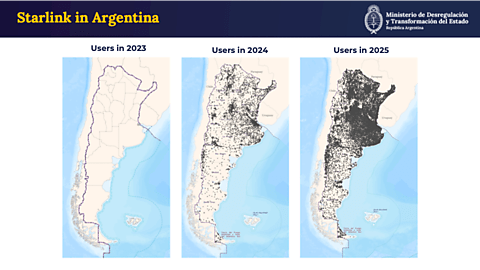
At a meeting I attended last month with a small group of economists, Argentina’s Minister of Deregulation, Federico Sturzenegger, presented the graph above. It shows how satellite internet use exploded once the government lifted its ban, which had, until then, benefited a politically powerful local internet provider.
In a recent paper, Sturzenegger describes how Argentines and businesses that were previously isolated or harmed by the high cost of the internet benefited from the deregulation:
Within weeks, several companies—most notably Starlink—began service. Roughly a year and a half later, about two million Argentines, particularly in remote areas, had access to satellite internet. The impact was immediate: mining and energy operations became more efficient, tourism expanded (a lodge owner in Patagonia told me recently he now gets clients who come precisely because they know they can work remotely), and precision agriculture became viable by simply mounting a satellite dish on farm machinery. What had been presented as a technical or safety issue turned out to be, in practice, the defense of a regulatory rent.
Argentina is a case study of how special interests produce regulation and can do so in the extreme. The Milei administration understands this and has so far reduced the bureaucracy by more than 65,000 people and eliminated or modified more than 2,500 regulations in a process of ongoing liberalization that promises to increasingly benefit Argentines.