
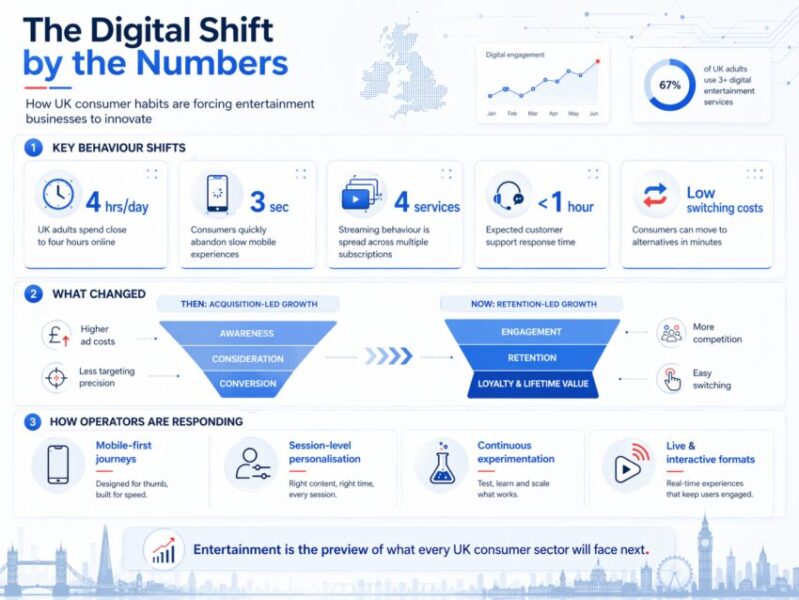
British consumers have stopped being patient. The average UK adult now abandons a mobile app that takes longer than three seconds to load, watches streaming content across four separate subscriptions, and expects a customer service response within the hour rather than the working day.
The cumulative effect on the entertainment sector has been the most significant behavioural shift since the arrival of broadband, and operators across every vertical — from cinemas to casinos, from Spotify to Sky — have spent the past five years rebuilding their businesses around a consumer who will churn for five pence of friction.
According to Ofcom’s Online Nation research, UK adults now spend close to four hours a day online, the majority of it on mobile devices, with attention fragmented across a growing catalogue of competing services. The strategic lesson underneath this pattern is not really about technology. It is about retention economics, and it applies well beyond entertainment. Any UK business competing for discretionary consumer spend — a point explored in our ongoing coverage of UK consumer behaviour trends — is operating in the same environment, facing the same expectations, and learning the same lessons the hard way.
The retention calculus has inverted
For most of the twentieth century, consumer businesses grew by acquiring new customers. Retention mattered, but it was a secondary metric. The assumption was that a reasonable product and a competent experience would keep most customers in place, and marketing spend was directed at the top of the funnel.
The digital shift inverted this. Customer acquisition costs across UK consumer categories have risen sharply, driven by Meta and Google ad inflation, data protection constraints that have narrowed targeting precision, and market saturation in most verticals. At the same time, switching costs for consumers have collapsed — comparison tools, portable accounts, and one-tap sign-ups mean that leaving one provider for another is now a three-minute decision rather than a three-week one.
The commercial consequence is that retention is now the primary growth lever in most UK entertainment businesses. The streaming cohort — Netflix, Disney+, Spotify, DAZN, Sky — spend materially more on product and personalisation than on acquisition marketing. Licensed UK gambling operators, arguably the sector under the heaviest retention pressure given that regulation continuously reduces their acquisition toolkit, have quietly become some of the most sophisticated customer-experience engineers in the British consumer economy. Independent review sites evaluating the best online roulette UK platforms publish detailed breakdowns of how these operators structure onboarding, retention mechanics, and responsible-play architecture — and the patterns on display are the result of a decade of forced innovation under regulatory pressure no other UK consumer sector has yet faced.
What high-retention entertainment businesses are doing differently
Three patterns recur across the most successful UK operators, regardless of vertical.
First, they have moved decisively to mobile-first product design. This is more than responsive layouts. It means rebuilding core flows — registration, payment, content discovery, support — around the reality that the majority of sessions now originate on a handset, often in short bursts of attention during commutes, breaks, or the half-hour between putting children to bed and falling asleep. Products designed for a desktop user with uninterrupted time fail silently in this environment. The operators winning are those who have redesigned their funnels assuming the user has forty seconds, one thumb, and an imperfect 4G signal.
Second, they have invested heavily in personalisation infrastructure. The old model — segment the audience into five or six personas and serve each a different homepage — is dead. Modern personalisation operates at the individual session level, adjusting content surfacing, messaging tone, promotional offers, and even interface complexity based on behavioural signals gathered in real time. Spotify’s weekly playlists, Netflix’s thumbnail variations, and the dynamic landing pages used by leading gambling operators are all manifestations of the same underlying investment in behavioural data infrastructure.
Third, they have shortened the feedback loop between product and commercial teams. Traditional consumer businesses release product updates quarterly and measure success in pooled cohort data. The high-retention operators run continuous experimentation programmes, A/B testing hundreds of changes per month with commercial KPIs visible to product teams in near-real time. The strategic effect is that product decisions stop being bets and start being iterations.
Regulation is not the enemy of retention
The shift above has happened simultaneously with a regulatory environment that has become substantially more demanding across UK consumer sectors. Financial services has the FCA’s Consumer Duty. Online platforms have the Online Safety Act. Gambling has a continuously tightening regime under the Gambling Commission’s LCCP framework. Food delivery faces evolving gig-economy rules. Even retail is navigating expanded product safety, digital markets, and advertising standards obligations.
The operators coping best with this compression have learned a counterintuitive lesson. Regulation is not the enemy of retention, and in some cases improves it. A customer who trusts the operator to handle their data well, flag risks honestly, and resolve complaints quickly is a customer who stays. The regulatory frameworks force the kind of customer-centric behaviours that sophisticated retention teams were trying to instil anyway. The businesses struggling are those that treated compliance as a cost centre rather than a product investment, and now find themselves retrofitting trust into a product architecture built for extraction.
This is particularly visible in gambling, where the regulatory envelope has tightened every year since 2020 — advertising restrictions, feature bans on auto-spin and turbo play, deposit thresholds triggering affordability checks, and a broader cultural expectation of demonstrable consumer care. Operators who responded by rebuilding their product around responsible engagement rather than maximised session length have retained customer bases that their more aggressive competitors have bled.
Live engagement as the new differentiator
The newest competitive frontier across UK entertainment is live, interactive content — and the strategic reasoning behind it is worth understanding even for businesses that will never livestream anything.
Passive content is increasingly commoditised. Every major streaming service has roughly the same library of prestige drama. Every bookmaker has roughly the same Premier League markets. Every music service has roughly the same fifty million tracks. Differentiating on catalogue is almost impossible at scale, and pricing power collapses accordingly.
Live, interactive engagement breaks this parity. A live dealer roulette table, a Peloton class with a real instructor, a Twitch stream with chat, a live podcast recording with audience questions — these experiences cannot be commoditised because each one is genuinely unique, time-bounded, and shared with other participants. The product becomes the moment, not the content, and the moment cannot be replicated by a competitor the following Tuesday.
The implications generalise. Any UK consumer business whose product could plausibly be delivered as a live or interactive experience should be investigating that option, because the retention premium on live engagement consistently exceeds the cost of producing it. Retail has learned this through shoppable livestreams. Fitness has learned it through class formats. Entertainment, broadly defined, is the next category where this lesson will compound.
The lesson for the broader UK economy
The UK entertainment sector is, in one respect, a preview of what every consumer-facing UK business will face within three to five years. The same acquisition cost pressure, the same mobile-first expectations, the same personalisation arms race, the same regulatory compression, and the same shift toward live and interactive formats will reach retail, financial services, hospitality, professional services, and beyond. The sectors that adapt earliest will retain margin. The sectors that treat the shift as a temporary disruption will lose it.
The strategic insight is simple and uncomfortable. The British consumer is not becoming more demanding because consumers have changed — the underlying psychology is the same as it ever was. They are becoming more demanding because the operators who set the benchmark in their daily digital lives have raised it to a level that other sectors will be measured against whether they like it or not. A utility company is now being compared, implicitly, to Monzo. A law firm is being compared to Gumtree. A specialist retailer is being compared to Amazon.
The entertainment sector got here first because the pressure hit first. The rest of the UK economy is catching up to the same conversation, and the operators watching closely are the ones who will survive it.
Read more:
The Digital Shift: How Consumer Habits Are Forcing the UK Entertainment Sector to Innovate