
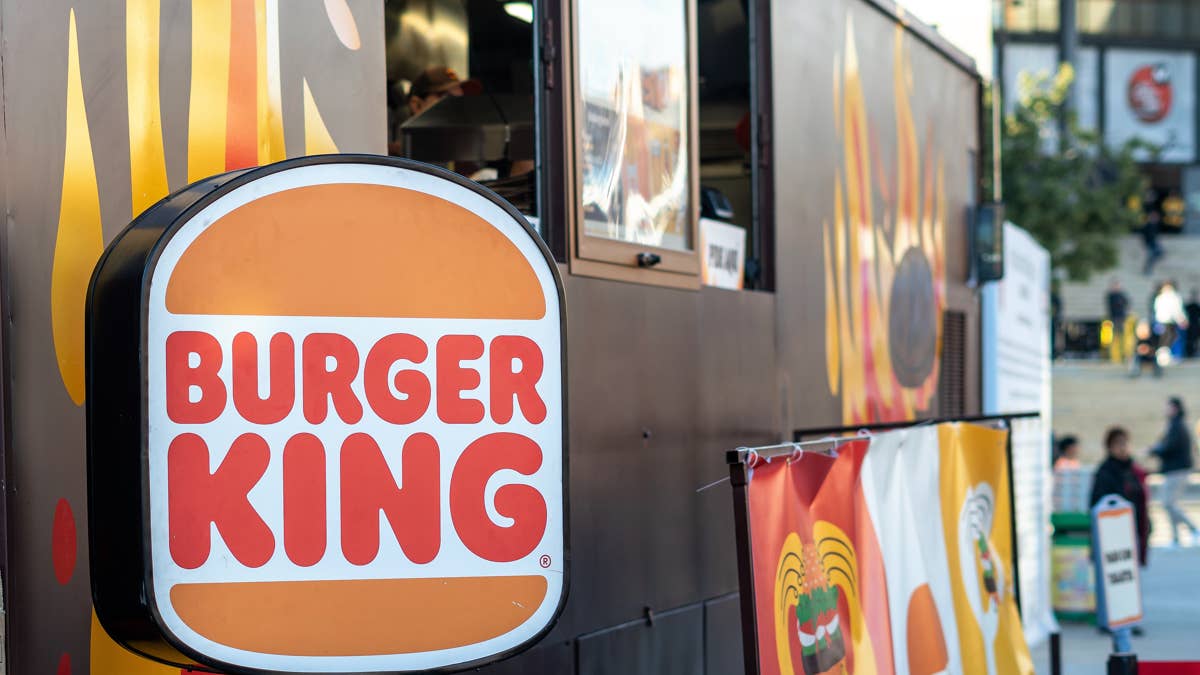
Burger King is back in second place.
The chain has passed Wendy’s to become the second-largest US burger brand by systemwide sales, a spot it lost six years ago.
McDonald’s still holds first place by a wide margin.
The change showed up in the latest earnings from parent company Restaurant Brands International (QSR), and it gave investors a clear read on how far the turnaround has come.
For anyone who owns QSR stock, or is thinking about it, the report offers something useful. It shows what a well-run comeback looks like, and it shows where the rest of the company still falls short.
How Burger King retook the No. 2 spot from Wendy’s
The two chains have moved in opposite directions for two years.
Wendy’s has now posted lower US same-store sales for six straight quarters, including a 7% drop in the second quarter.
Burger King has gone the other way, with US same-store sales up in each of the last five quarters.
More Consumer Stocks:
- Starbucks CEO silently repeats Chipotle’s playbook
- Albertsons stock in hot water after sobering reveal
- Nike stock could suffer because of JPMorgan verdict
Burger King’s US same-store sales rose 8.5% in the second quarter, CNBC reported. That result beat McDonald’s, which grew just 0.8%, and it towered over Wendy’s decline.
The credit goes to a plan the company started in September 2022. Burger King committed $400 million to a program called “Reclaim the Flame,” according to StockTitan.
What Burger King actually changed to win customers back
The money went to three things.
The first was food. Burger King upgraded core items, including new buns and better mayo on the Whopper, to bring back customers who had drifted away.
The second was the kitchen. The company spent on digital tools and equipment to speed up drive-thru lines and cut order mistakes.
The third was the buildings. Burger King co-invested with strong franchisees to remodel old stores and take over locations from operators who went bankrupt.
That last point matters for investors. A cleaner, faster restaurant lifts sales per location, and higher sales per location is what pulled Burger King past Wendy’s.
Manuel Milan / Getty Images
Inside Restaurant Brands’ second-quarter numbers
Restaurant Brands earned an adjusted $1.07 per share, beating the $1.03 that Wall Street expected, CNBC reported. Revenue came in at $2.52 billion, up about 4.5% from a year earlier.
Companywide same-store sales rose 3.8%, and systemwide sales grew 6.4%, according to a Restaurant Brands press release.
Here is how the four burger players compared on US same-store sales for the quarter:
Q2 2026 US same-store sales
- Burger King: +8.5%
- McDonald’s: +0.8%
- Tim Hortons (Canada): +0.1%
- Wendy’s: -7.0%
- Popeyes: -5.2%
One brand carried the quarter. The others stayed flat or fell.
Why QSR stock slipped even after a strong quarter
The stock did not rally on the news.
QSR shares slipped about 1.6% in Thursday trading, even with the earnings beat, Yahoo Finance reported. The stock closed at $73.89 on Thursday, August 7.
The reason sits in the rest of the portfolio. Popeyes posted a 5.2% drop in US same-store sales, its sixth straight quarter of decline.
Related: Coca-Cola absorbs margin hit for expansion in key market
Tim Hortons grew just 0.1% in Canada.
So investors saw one brand doing the heavy lifting while two others struggled. That mix explains the muted reaction.
The company also kept returning cash. Restaurant Brands handed $435 million back to shareholders through dividends and buybacks in the quarter, according to Investing.com.
The Popeyes problem QSR still has to fix
Popeyes is the clearest drag on the company right now. The chain is in its worst sales slump in more than two decades.
Its rapid growth after the 2019 chicken sandwich launch left many kitchens hard to run, and some large operators fell into bankruptcy, which forced store closures.
Management has a fix underway called “Easy to Love,” aimed at full US rollout by the end of 2026.
The plan simplifies the menu, adds automation to speed up cooking, and introduces modern digital ordering systems.
CEO Josh Kobza told investors he expects Popeyes same-store sales to start growing again in the second half of 2026, CNBC reported.
Until that happens, Popeyes will keep pulling down the company’s overall growth rate.
Wendy’s cut its dividend, and that changes the comparison
Wendy’s did not just lose a ranking. It changed how it pays shareholders.
In the same week, Wendy’s withdrew its full-year 2026 outlook and cut its quarterly dividend in half, from 14 cents to 7 cents per share, Bloomberg reported.
New CEO Bob Wright said the company is not performing at its potential, but is building a turnaround plan.
That matters for income investors weighing the two stocks.
A dividend cut signals that a company needs to protect cash, while Restaurant Brands raised its payout for an 11th straight year, Investing.com reported.
QSR pays a quarterly dividend of $0.65 per share. At the recent price of close to $74, that works out to a yield of about 3.5%.
How QSR stock stacks up against McDonald’s and Wendy’s for investors
The three burger stocks now sit in very different places.
Wendy’s trades cheap, but the low price comes with a cut dividend and a withdrawn forecast, so the discount reflects real trouble rather than a bargain.
McDonald’s trades at a premium and offers stability, but its 0.8% US sales growth shows little near-term momentum.
Restaurant Brands sits in the middle. Building on the Burger King recovery, it offers faster growth than McDonald’s, plus a dividend that is still rising, unlike Wendy’s.
Three things QSR investors should watch next:
- Whether Popeyes returns to positive same-store sales in the second half, as management promised.
- Whether Tim Hortons can move beyond flat growth in Canada.
- Whether Burger King holds its lead over Wendy’s, since Wendy’s is now planning its own recovery.
What the quarter means if you own, or are eyeing, QSR
The main takeaway is simple. Burger King is no longer the company’s weak spot, and that removes a long-standing worry for shareholders.
But one strong brand does not represent the whole company. Total returns will stay capped until management applies the Burger King playbook to Popeyes and Tim Hortons.
If you already own QSR, the dividend and the Burger King recovery give you reasons to hold.
If you are looking to buy, the second-quarter Popeyes report is the number to watch, because that is where the next leg of growth has to come from.
None of this is a promise of gains. A recovery at one brand can stall, and beef and chicken costs can squeeze franchisee profits.
The Burger King turnaround shows the company can fix a struggling brand. Now it has to prove it can do that twice more.
Related: Coca-Cola keeps beating its rivals, and Wall Street noticed